Our farm house cellar was a place of dread for me. Damp, dark, pungent. Cracks in the foundation floor. I didn’t dread it for those reasons though. I feared the salamanders under the wooden stairs.
Mom would tell me to get a jar of pickles, canned pears or peaches, or sometimes a few more eggs. I’d whine that I was scared of the salamanders. They might run up my leg, bite my toes, or hiss at me, I thought.
Mom
would hear none of that. “Those buggers are more scared of you than you
are of them. Just go real fast and they’ll run away.”
And they would. Every time.
But I still didn’t like doing it.
Funny
how the daddy longlegs that lived among the pots and pans
and the store-bought canned goods in the stairway on the way down never bothered me.
That cellar, stench and all,
still exists. The hot water heater is down there, and my dad put a water distiller in there years ago. One time he had jugs of extra water all over the place.
The room carries a wet-earth odor. A small screened window to the east lets in light along with a single light bulb. Maybe
Mom had a board she’d put up there in a big rain storm to
keep it from flooding, but I don't remember. In the South Dakota winters, Dad would pile
straw bails in front of it.
The cellar houses a couple old wooden chairs and some makeshift wooden shelves
for all the home canned goods. In the middle of the room are a couple poles with a table
top. It is taller than counter height. Mom kept her canning supplies on
it with the cleaned out jars.
I remember only one time taking cover
in that basement, ah, I mean cellar, during a storm.
I was already
teaching in Kansas, but was home for the summer. My sister Priscilla and
her daughter Angela were up for a visit when Dad came in yelling, “You
guys take cover. Get in the basement.” Then he headed back outside.
After Mom questioned where he was going, he hollered, “I’m going driving. Gotta see what’s coming around the trees.”
Typical.
We
grabbed our purses, a couple of blankets, and Grandma Katie’s old
transistor radio and headed to the cellar. I wasn’t concerned about any
salamanders then.
We hadn’t been down there very long when a loud bang startled us.
“That’s the front door,” Mom said. “Wind must have blown it open. It’s banging back and forth now.”
Angela
mentioned our family dog, Jupiter, our black and white cocker spaniel who showed up one July day in 1994 after a comet hit the planet,
thus the name.
“She’s in with the boars,” Mom assured Angela.
The
door kept banging, so I said I’d go up and shut it and come right back.
Neither Mom nor Priscilla protested, and I don’t remember being scared
to do it. After all, my dad was out in this. It was just a terrible wind,
right?
I think this was the storm that my brother Elliott, his wife Doris, and daughter Suzanne stood by one of their kitchen windows and
watched an old hog barn (which as little kids, we’d dubbed the Laura Ingalls Wilder playhouse), roll back and forth towards the house. If it wasn’t this storm, then it must have been another one. That building never did hit their house or
vehicle, but it rolled itself out of existence and ended up as a pile of boards.
Back at our place, I was able to close the
outside door and return to the cellar unharmed. When it was all over,
I don’t recall any major damage to our farm.
A few years ago, the family was talking about Dad's cellar, and Angela, now a full-grown adult with a family of her own, remembered the evening we took cover. She said she was so scared. Not of the storm. Not of any
salamanders. Not of the creepiness of the place, but of losing me.
She
said that she thought she’d never see me again when I went up those stairs to
close that door. She described her feelings so vividly. She'd never told me that.
Salamanders or storms, I’ve never spent much time in that cellar.
But
my Grandma Elizabeth did when my two older sisters were little—just
enough time for Priscilla to cut Brenda’s hair while Grandma was down
there sorting eggs.
Oh, if those cellar walls could talk.
Do you remember a room from your childhood home that gave you the heebie-jeebies? What about now? Is there a place that gives you the willies?

Showing posts with label Grandma Elizabeth. Show all posts
Showing posts with label Grandma Elizabeth. Show all posts
Sunday, September 20, 2015

Tuesday, July 14, 2015
Piece of Furniture Finds its Forever Home
A piece of furniture that used to hold oil cans in my dad's garage now sets inside my house.
It's filled with books, items from my childhood, and other things I packed away in tubs when I needed to make room for a husband and step-daughter.
My crafty friend Valerie Shellhammer helped me refurbish this jewel.
When my brother-in-law Jeff saw it earlier this summer, he said, "It was a pie safe." He pointed to the screens on the top doors. "Flies wouldn't get in the pies that way," he added.
So that's what I'm calling it. The pie-safe bookcase.
Here's its story.
Dad said, "Are you sure you want that thing? It's really oily."
I did. I had magazine pictures from years ago of what I wanted to turn it into.
Dad didn't know that as a little girl, I had an entire plan of how to turn that yucky garage into a studio apartment. That bookcase was a key component of the design.
Yes, I have quite the imagination. Maybe when I'm 90 like he is, and if the garage is still standing, I'll renovate that garage into cottage I dreamed it could be.
Anyway, he let me have this cabinet, and that's when I learned there were doors for it. The top had that chicken wire, but the bottom doors were solid. Dad cleared out his stuff and packed it up for the trip from South Dakota to Kansas.
 My brother-in-law Rick used my brother Elliott's pick-up to haul it down here. He brought a couple more items from the farm too.
The bookcase, a two-piece outfit, sat in my shed except for the times I took it out to scrape it.
I remember my friend and colleague Tim Hiebert bringing me, a relatively new home owner, a weed eater he'd picked up from a garage sale. That was somewhere in the mid to late '90s on Labor Day weekend.
 Why do I remember that? Because he startled me when he walked into the backyard while I was scraping it. Tim said it looked like I had my work cut out for me.
And I remember the weekend because I thought I could get the thing completely scraped and done in a few days.
Work it was. Lots of elbow grease.
What I found underneath was shocking.
Red. Red paint.
Grandma Elizabeth, who no doubt had this in her house, must have painted it red. (Read "Namesake" by clicking here to know more about her.) Oil also seemed to seep from one corner.
I decided I'd better measure the thing. It was too tall for my house—if I was going to use both parts. I have low seven-foot ceilings, and this thing was nearly 10 feet tall.
My dream project went back in the shed to be infested with wasp hives and bird poop. Not much different than its life on the farm in the garage.
That was around 15 years ago.
After I got married in 2006, we moved the bookcase from the shed to our newly built garage, so the bookcase got cleaned up a bit for that. It stored lots of stuff on its open shelves with the doors setting on top collecting spiders. I still had dreams of it being inside the house some day though.
One summer my husband Chris bought me a hand sander, so I could use electric power to continue to clean up the thing. It worked. I went through a lot of sandpaper, but it worked.
A couple more years passed.
Brittany moved on to college and then out on her own. Her teenage room got redesigned back into a guest room. Here was my chance to get that thing in the house.
Valerie and I checked out vintage stores in Wichita for ideas. She snapped pictures. I bought paint. We had good intentions. But life happened.
And so it remained.
In the garage storing golf balls, flower vases, sander equipment, old yearbooks—not what I had envisioned for the thing years ago.
 One day, Valerie said, "Let's get your bookcase done.
So on November 6, 2014, our first cold day of the fall season, we painted it with white chalk paint in the garage.
My husband had to cut off about two-and-half inches from the bottom, so it would fit in the house when finished.
Val finished up the doors at home.
Months pass.
Then finally in May, the entire thing was done. We put some sort of glaze on it. Smooth surface now.
Val found new hinges, but we saved the original clasps.
 Oh, if those clasps could tell me the hands that have touched it throughout the years.
Finally, my dream piece had its new home inside the house.
I had fun arranging the items in it on my first full day of summer vacation. It took me all afternoon, but I wanted to make it look inviting to the point that if you came to my house, you'd love snooping around in the thing.
You'd figure out a lot about me through the book titles, the cups filled with bookmarks, the newspaper clippings and pictures arranged in boxes by year or topic. If my memory ever starts to fade, this will be my go-to place.
Sentimental me sure enjoys going in there, pulling out a box, reading through old notes.
After 26 years of teaching, I have a lot of notes from students—and I believe I have kept every one.
My Cousin Cynthia gave me Aunt Mary Ruth's notes from the state quilt she made me when she finished the embroidery squares that Mom had started. Precious to see her handwriting and planning.

Letters from my sister-in-law Doris when I first attended college. I've always loved her fancy cursive writing. And letters from Mom too. Kept in the envelopes with the dates stamped on them.
Notes from college pals. Homemade cards from my eight nieces and nephews who are now all adults. The vocabulary list of a made-up language my niece Jessica and I tried to invent one summer.
Notes from Steve Elliott and his mom about how thankful they were for the connections we made while I student taught at Halstead the fall of 1988. I would not have stayed with teaching if it wasn't for Steve, but that's a story for another post.
Material things. Yes. But things from events, students, and people that matter. This bookcase keeps them safe. Just like it did Grandma's pies.
Have you ever taken on a project that spanned two decades to complete? Have any items from an earlier time that you wished could be at your fingertips? Any family heirlooms in your home?
It's filled with books, items from my childhood, and other things I packed away in tubs when I needed to make room for a husband and step-daughter.
My crafty friend Valerie Shellhammer helped me refurbish this jewel.
 |
| at home in the house |
When my brother-in-law Jeff saw it earlier this summer, he said, "It was a pie safe." He pointed to the screens on the top doors. "Flies wouldn't get in the pies that way," he added.
So that's what I'm calling it. The pie-safe bookcase.
Here's its story.
Dad said, "Are you sure you want that thing? It's really oily."
I did. I had magazine pictures from years ago of what I wanted to turn it into.
Dad didn't know that as a little girl, I had an entire plan of how to turn that yucky garage into a studio apartment. That bookcase was a key component of the design.
Yes, I have quite the imagination. Maybe when I'm 90 like he is, and if the garage is still standing, I'll renovate that garage into cottage I dreamed it could be.
Anyway, he let me have this cabinet, and that's when I learned there were doors for it. The top had that chicken wire, but the bottom doors were solid. Dad cleared out his stuff and packed it up for the trip from South Dakota to Kansas.

The bookcase, a two-piece outfit, sat in my shed except for the times I took it out to scrape it.
I remember my friend and colleague Tim Hiebert bringing me, a relatively new home owner, a weed eater he'd picked up from a garage sale. That was somewhere in the mid to late '90s on Labor Day weekend.
 Why do I remember that? Because he startled me when he walked into the backyard while I was scraping it. Tim said it looked like I had my work cut out for me.
And I remember the weekend because I thought I could get the thing completely scraped and done in a few days.
Work it was. Lots of elbow grease.
What I found underneath was shocking.
Red. Red paint.
Grandma Elizabeth, who no doubt had this in her house, must have painted it red. (Read "Namesake" by clicking here to know more about her.) Oil also seemed to seep from one corner.
I decided I'd better measure the thing. It was too tall for my house—if I was going to use both parts. I have low seven-foot ceilings, and this thing was nearly 10 feet tall.
My dream project went back in the shed to be infested with wasp hives and bird poop. Not much different than its life on the farm in the garage.
That was around 15 years ago.
After I got married in 2006, we moved the bookcase from the shed to our newly built garage, so the bookcase got cleaned up a bit for that. It stored lots of stuff on its open shelves with the doors setting on top collecting spiders. I still had dreams of it being inside the house some day though.
One summer my husband Chris bought me a hand sander, so I could use electric power to continue to clean up the thing. It worked. I went through a lot of sandpaper, but it worked.
A couple more years passed.
Brittany moved on to college and then out on her own. Her teenage room got redesigned back into a guest room. Here was my chance to get that thing in the house.
Valerie and I checked out vintage stores in Wichita for ideas. She snapped pictures. I bought paint. We had good intentions. But life happened.
And so it remained.
In the garage storing golf balls, flower vases, sander equipment, old yearbooks—not what I had envisioned for the thing years ago.
 One day, Valerie said, "Let's get your bookcase done.
So on November 6, 2014, our first cold day of the fall season, we painted it with white chalk paint in the garage.
My husband had to cut off about two-and-half inches from the bottom, so it would fit in the house when finished.
Val finished up the doors at home.
Months pass.
Then finally in May, the entire thing was done. We put some sort of glaze on it. Smooth surface now.
Val found new hinges, but we saved the original clasps.
 Oh, if those clasps could tell me the hands that have touched it throughout the years.
Finally, my dream piece had its new home inside the house.
I had fun arranging the items in it on my first full day of summer vacation. It took me all afternoon, but I wanted to make it look inviting to the point that if you came to my house, you'd love snooping around in the thing.
You'd figure out a lot about me through the book titles, the cups filled with bookmarks, the newspaper clippings and pictures arranged in boxes by year or topic. If my memory ever starts to fade, this will be my go-to place.
Sentimental me sure enjoys going in there, pulling out a box, reading through old notes.
After 26 years of teaching, I have a lot of notes from students—and I believe I have kept every one.
My Cousin Cynthia gave me Aunt Mary Ruth's notes from the state quilt she made me when she finished the embroidery squares that Mom had started. Precious to see her handwriting and planning.

Letters from my sister-in-law Doris when I first attended college. I've always loved her fancy cursive writing. And letters from Mom too. Kept in the envelopes with the dates stamped on them.
Notes from college pals. Homemade cards from my eight nieces and nephews who are now all adults. The vocabulary list of a made-up language my niece Jessica and I tried to invent one summer.
Notes from Steve Elliott and his mom about how thankful they were for the connections we made while I student taught at Halstead the fall of 1988. I would not have stayed with teaching if it wasn't for Steve, but that's a story for another post.
Material things. Yes. But things from events, students, and people that matter. This bookcase keeps them safe. Just like it did Grandma's pies.
Have you ever taken on a project that spanned two decades to complete? Have any items from an earlier time that you wished could be at your fingertips? Any family heirlooms in your home?
Saturday, May 23, 2015
30-day Writing Streak Turns into a Year
Last year on May 18, I told
myself I had to write for 30 days straight. I managed to do it for an entire
year.
Why had I set that goal to
begin with?
I had a writers’ conference
in a month that I had paid for. It was an eight-hour drive away, and if I couldn't
commit to write for 30 days in a row, I had no business investing money in my
long-time dream to become published.
When I wrote for just seven
days straight, I was ecstatic. I had never done that. Not even in college.
This writing-every-day
commitment was more than my usual 5-year-short-diary entry. In that, I mimic
what my Grandma Elizabeth and Mom did in theirs. It's a log of what we did,
what I cooked, current event info, and the weather. Grandma included how many
eggs she got, and Mom referred to work on the farm. I mention school events and
Chris’ picture taking successes.
So I defined this writing
every-single-day thing. To me in meant deliberate work on a passage in order
to make it publishable. Some days I wrote a draft. Others, I revised—which by
the way, is the most enjoyable part of writing for me, but that means my drafts
are nasty typo-ridden pieces that get all marked up.
 |
| One of my many writing spots. Here was my set-up for the SCBWI webinar with Elizabeth Law on May 2. |
There were days that it was a battle, and some days I only wrote a
couple sentences, but I still set the time aside to do it. It had gotten too late. I’d graded 50-some papers
written by 12-year-olds. I didn’t know what to write about. But I did not want
to break my steak, so I forced myself.
The worst and more dangerous excuse?
This is a waste of time.
That thought came when I was tired or hungry. I noticed those negative thoughts during other work too, not just writing. It may be common sense to most people, but since I'd developed workaholic tendencies from my mom (click here to read about that), the realization was life-changing for me. It was okay to leave things undone and take care of physical needs.
That thought came when I was tired or hungry. I noticed those negative thoughts during other work too, not just writing. It may be common sense to most people, but since I'd developed workaholic tendencies from my mom (click here to read about that), the realization was life-changing for me. It was okay to leave things undone and take care of physical needs.
I actually enjoyed my day job
more because I had set aside time for my hobby. I was mentally prepared to
return to work because my mind had actually left the place for awhile.
To make room in my schedule
to write every day, I had to change some things. I watched less TV. I didn't
talk on the phone as much. I didn't micromanage myself at work. I said no to
other activities. I cooked bigger batches and fed my husband three days of
leftovers instead of two.
I also kept a log with the
following headings: date, study of the publishing world, what I wrote today,
Damien work (my middle grade WIP about a boy with an imaginary elf on his right shoulder). Looking back at the log and celebrating small successes helped me forge
ahead.
Considering this yourself? Click here for an encouraging list of writing memes. It was compiled by writer Linda W. Yezak, one of the first writers' blogs from which I drew encouragement.
Considering this yourself? Click here for an encouraging list of writing memes. It was compiled by writer Linda W. Yezak, one of the first writers' blogs from which I drew encouragement.
This writing-every-day
routine might not work for everyone. If you're the persistent type, it could. If
the pressure of just one more thing, would do you in, then don't. Consider starting small like I wrote
about here in the habit stacking post.
For many years I tried to establish a writing habit, but this write every-single-day thing worked for me. The timing was
right, I guess, and I'd invested the money. I knew I needed to take action if I
ever wanted my publishing dream to become reality. In the course of my study it, I’ve learned so much, but that’s for another post.
I do know that I will continue to write even if my WIP doesn’t see the light of day. I enjoy it that much.
I do know that I will continue to write even if my WIP doesn’t see the light of day. I enjoy it that much.
Did I achieve what my
original write-for-30-days-in-a-row commitment intended? You bet. Now the day
isn't done unless I have written.
Have you tried doing
something everyday? What were your results? Now that summer vacation has
arrived, do you have any mid-year resolutions? What plans have you put in place
for success?
Saturday, April 18, 2015
What I Never Knew About My Parents' Wedding
At the start of it all, Mom knew Dad was a night owl when she married him. For
weeks leading up to their wedding in 1944, Dad would visit her at 10 o’clock at night.
Mom lived miles away in Doland, South Dakota. She worked at the Northwestern
Public Service office and had graduated from high school the spring before in
1943.
So the ceremony was simple and short without a lot of hoopla. In fact, his sister Mary Ruth and mother just made sure all the important parties were in church that day.
 |
| Mom, 18-years-old, on her wedding day when Dad, 19, came to pick her up |
My
dad’s dad, Grandpa Pete, had died a month earlier (I’ll explain more in future
post) on March 18, so at the age of 19, my dad became the man of the farm near Hitchcock with plenty of
work to do. Grandma Elizabeth, Dad’s mom whom he lived with on the farm and whom I wrote about here, didn’t
like the late night visits, so she encouraged them to get married.
The
ceremony took place on a Sunday morning after the main church service on April
16, 1944 at Ebenezer church. It was the custom for the woman to go with the man, so that's why the ceremony wasn't at Emmanuel, Mom's church. Dad drove to Doland during the Sunday school
hour to pick up Mom, her mother, and one of her sisters. They had no car.
 |
| Stella & Waldo's wedding portrait |
Back in the day, men
and women sat on opposite sides of the sanctuary in the Mennonite Brethren
Church, but for this occasion, the bride and groom sat up on stage in front of
the minister, Reverend DJ Mendel (Smoky Joe's dad), with their backs to the congregation. It was just
a regular church service until the end when a short marriage ceremony was
performed.
Dad
said he has no idea what the sermon was about that day. The entire service
was in German and rather than say “I do,” they said, “yah” to commit. And
there was no kiss-the-bride announcement either. Dad doesn’t
remember where their attendants, Aunt Bina and his cousin Miller Glanzer, were during the ceremony.
He does recall; however, tears rolling down his cheeks when my mom's other sister, Aunt Grace, and neighbor lady Ruth Decker sang "Blessed be the Tie that Binds." Click here to hear the lyrics and various renditions of the old hymn.
He does recall; however, tears rolling down his cheeks when my mom's other sister, Aunt Grace, and neighbor lady Ruth Decker sang "Blessed be the Tie that Binds." Click here to hear the lyrics and various renditions of the old hymn.
 |
| Dad & Mom with their wedding cake on the south side of the house |
So the ceremony was simple and short without a lot of hoopla. In fact, his sister Mary Ruth and mother just made sure all the important parties were in church that day.
Grandma Elizabeth invited the minister and his wife Katrina and
other close family members to the house then for a celebration dinner of noodle soup.
Dad remembers my cousin Judy running around and estimates she was around
3-years-old. Cousin Cynthia was there too, but younger. Maybe my cousins can fill in some blanks here by commenting on the blog as to what they remember.
 |
| Mom's family makes a visit. Aunt Bina, Aunt Grace with Cousin Judy in front, Grandma Katie, and Mom |
What about the opening of gifts? Dad doesn't remember that part. Seems Grandma
Katie, my mom’s mom, gave Mom a wardrobe for a wedding gift, but it was too
tall for the room, so they had to take it back to Doland. Dad doesn’t know
about any replacement gift. He doesn’t remember how the item was transported
either or when the exchange was even attempted.
There was no honeymoon. Dad said the next day Mom was on her hands and knees scrubbing the floor in the front room upstairs. Sounds like Mom. Work before play. Always. I am a lot like her.
There was no honeymoon. Dad said the next day Mom was on her hands and knees scrubbing the floor in the front room upstairs. Sounds like Mom. Work before play. Always. I am a lot like her.
Sure
wish I’d have talked with Mom more about this sort of thing when she was alive because she
had a photographic memory. But I’m glad that on his 71st wedding anniversary, Dad still
remembers a few precious details of the day he married the only woman he'd ever
kissed.
Any interesting wedding details in your families? How about the circumstances of your parents' wedding?
Any interesting wedding details in your families? How about the circumstances of your parents' wedding?
Sunday, January 11, 2015
The Middle Years of a 90-Year-Old's Life
Dad has always seemed old to me since he was 41-years-old by the time I came along.
So when we celebrated his Christmas Eve birthday a couple weeks ago, his white hair and 90 candles made me realize that now he really is old.
What follows catalogs Dad's mid-life years as a 40-50-60-year-old when he raised his last child (me) and began his role as a father-in-law and a grandpa. These are some of the advancements and changes a middle-aged farmer from east central South Dakota experienced from 1954 to 1984.
For Dad's younger years, read the earlier post, First 30 years of My Dad's 90-Year-Old Life.
Part II: The Next 30 Years
Developments on the Farm: 1954-1964, Decade #4
TV Enters the Home
After Mom and Dad poured the cement foundation for a granary all by themselves, they weren’t quite sure what to do next until neighbor Josh Hofer came along and offered to help. They paid him a dollar an hour in 1954. When the job was done, Josh earned a $500 bonus.
Not long after my Grandma Elizabeth's death in '55 (I wrote about her in Namesake), neighbor Dave T. Decker sold his farm to Dad in 1958. This farm, with one white silo, was a little over a mile away from the main place and would eventually be my brother's home with his wife and five children, the nieces and nephews with whom I grew up.
Growing Family: 1964-1974, Decade #5
Lots of Lambs and Hogs ~ in other words, a ton of work
A highlight of this decade was witnessing the 1969 moon landing. The folks saw it on TV with Warren and Mary G Wipf while stopping to eat at a truck stop in Mitchell. Mary G was Mom's cousin whom I wrote about here.
The Marken family moved onto the other farm as Dad's hired help, and Dad began raising sheep. Before I was born, the Marken's left, so Dad hired Roy Horsley. Roy raised sheep too, so this was a big help. Dad recalled driving with him all the way to Hutchinson, Kansas, to purchase more sheep. The barn on the second farm was full of them. So full, that they took turns pulling all-nighters to keep an eye on them.
Sheep, when born, need to be in a small pen with the mother. They can't mingle like calves do, Dad said. They must be given time to adjust. Out of room in the main barn, the men had to shuffle pens around inside and out. It was such a struggle that Roy said he wouldn't go through another lambing season like that. So, not wanting to lose an expert sheep farmer, my progressive father built another barn.
A problem arose one time when it was time to sheer the sheep. Cold weather arrived, and the heat of the sheep rose to the frosty roof consisting of only plywood with no shingles. The dripping from the roof made the sheep too wet to sheer. Dad rounded up all the Nipco heaters he could find from the neighbors. He hung them from the rafters to dry off the critters, so the scheduled sheep sheering day could proceed.
I barely remember those sheep days. I'd fall asleep on an old couch in the barn after I had been told to get off the bus at Horsley's because everyone was over there tending to the lambs. Ironically, as I was working on this post, Roy passed away. Click here for his obituary.
In July of 1970, a few days after I turned 4-years-old, the family took their first commercial airplane trip. It was to Detroit for my brother Elliott's wedding. Read Curlers, a Bra, and an Airplane Ride for details about that wedding and others. Elliott eventually moved back to farm with Dad about the time the Horsleys moved back to Wessington Springs, Roy's hometown.
But before Roy left, Dad got into hogs, since Roy was a hog man too. A hog farrowing barn was built, and they'd planned to furrow four times a year. "The first time we weened 400 pigs," Dad said. I wrote about this building here in my Why I Hate Birds series last summer. But by the time Elliott returned to South Dakota to farm with Dad, the building had been sanitized and locked up. He was done with hogs—for now.
In 1973 and 1974, a slick salesman talked Dad into putting up two
blue Harvestores with an automated feeding system. I enjoyed the smell of silage and would pretend I was an assembly line worker at McDonald's—only I'd be serving cattle. These blue tubes forever changed the landscape of the farm. Dad now says, "I would have fared very well without that purchase."
Trying Times: 1974-1984, Decade #6
Drought & Debt
Had the worst crop in 1976. Dad suffered from migraine headaches.
Pastures were bare. One time he closed off the township road and put a up a "disaster area" sign so the cattle could graze the ditches. By the end of the day, those were bare too.
These are the years in which I grew up.
Dad ended up selling all the cattle. Mom stood at the screen door and cried as the semi trucks drove off with the livestock. But like all farmers, Dad still had hope. Hope for rain, for a crop, for an income.
In retrospect, Dad said he wished he would have kept and cows and sold the feeder cattle, but he followed the predictions that the following year was going to be dry too. It wasn't. The grass grew three feet tall.
Elliott kept asking Dad, "When you gonna get back into hogs?" Dad said a few days would go by and his son would again ask, "Ever gonna get back to raising hogs?"
And boy did they. Eventually, a larger hog confinement operation was constructed. It included a cage room, a nursery, and a finishing house. My cousin Wilmer Kleinsasser (whom I wrote about here and here), was hired on as a farmhand, and he hauled the pork to Huron for slaughter. I always thought it was rather sad that some hogs never saw the light of day until that fateful ride. Those hogs help pay for my college education.
Another building came about after my brother-in-law Rick helped Dad and Elliott clear the spot where the Butler Building, a machine shed, was to be located. I loved that building, even though birds sometimes got in, for it was my indoor basketball court—when Dad finally followed through on a promise to get me one. He hired Gene McMillian in the early 80's to create the movable goal—and not the kind that just changed the height of the hoop. The entire thing could be moved, inside or out. It cost $300.
My dad, always the elaborate one. He never does things small-scale.
Despite the stress of the farm, Dad's always been a man of progress and dreams. Farming is a gamble. And the entire family was a part of the risk. A family, that by now, included quite a few grandchildren.
Do you have relatives like my dad? Any risk takers among your ancestors? Any big dreamers? Maybe you possess those traits and would like to share.
Writer's Note: In the next post, Old Age Creeps In: Decades 7, 8, and 9.
So when we celebrated his Christmas Eve birthday a couple weeks ago, his white hair and 90 candles made me realize that now he really is old.
 | |
| A family picture before me. Standing man: a German foreign exchange student. |
What follows catalogs Dad's mid-life years as a 40-50-60-year-old when he raised his last child (me) and began his role as a father-in-law and a grandpa. These are some of the advancements and changes a middle-aged farmer from east central South Dakota experienced from 1954 to 1984.
For Dad's younger years, read the earlier post, First 30 years of My Dad's 90-Year-Old Life.
Part II: The Next 30 Years
Developments on the Farm: 1954-1964, Decade #4
TV Enters the Home
After Mom and Dad poured the cement foundation for a granary all by themselves, they weren’t quite sure what to do next until neighbor Josh Hofer came along and offered to help. They paid him a dollar an hour in 1954. When the job was done, Josh earned a $500 bonus.
 |
| the granary: the building with a smile, according to my nieces who lived nearby |
In 1957, a telephone company installed phone lines, quite different from the farmer's lines I wrote about last time. A party
line consisted of ten homes per line. Each home had a different ring, so if you wanted to eavesdrop, quietly lift the receiver.
Also in that year, Dad purchased the family's first TV, a Silvertone. Before that, Uncle Jr. was the first one with a television. "The picture was just white fuzz up at Jr.'s," Dad said. "By the time we got ours, the reception was better."
In this decade, Dad also bought two 560 International tractors, two cultivators, and two five bottom plows. The landscape of the farm changed in 1963 when two white concrete silos were constructed.
Also in that year, Dad purchased the family's first TV, a Silvertone. Before that, Uncle Jr. was the first one with a television. "The picture was just white fuzz up at Jr.'s," Dad said. "By the time we got ours, the reception was better."
 |
| Is that a Silvertone TV behind me one Christmas? (I have stitches by my eye, long story) |
In this decade, Dad also bought two 560 International tractors, two cultivators, and two five bottom plows. The landscape of the farm changed in 1963 when two white concrete silos were constructed.
Not long after my Grandma Elizabeth's death in '55 (I wrote about her in Namesake), neighbor Dave T. Decker sold his farm to Dad in 1958. This farm, with one white silo, was a little over a mile away from the main place and would eventually be my brother's home with his wife and five children, the nieces and nephews with whom I grew up.
 |
| Elliott's farm in 2011 ~ currently only a sheep barn, not pictured above, remains |
Growing Family: 1964-1974, Decade #5
A highlight of this decade was witnessing the 1969 moon landing. The folks saw it on TV with Warren and Mary G Wipf while stopping to eat at a truck stop in Mitchell. Mary G was Mom's cousin whom I wrote about here.
The Marken family moved onto the other farm as Dad's hired help, and Dad began raising sheep. Before I was born, the Marken's left, so Dad hired Roy Horsley. Roy raised sheep too, so this was a big help. Dad recalled driving with him all the way to Hutchinson, Kansas, to purchase more sheep. The barn on the second farm was full of them. So full, that they took turns pulling all-nighters to keep an eye on them.
Sheep, when born, need to be in a small pen with the mother. They can't mingle like calves do, Dad said. They must be given time to adjust. Out of room in the main barn, the men had to shuffle pens around inside and out. It was such a struggle that Roy said he wouldn't go through another lambing season like that. So, not wanting to lose an expert sheep farmer, my progressive father built another barn.
 |
| the sheep barn on Elliott's yard in 2011 |
A problem arose one time when it was time to sheer the sheep. Cold weather arrived, and the heat of the sheep rose to the frosty roof consisting of only plywood with no shingles. The dripping from the roof made the sheep too wet to sheer. Dad rounded up all the Nipco heaters he could find from the neighbors. He hung them from the rafters to dry off the critters, so the scheduled sheep sheering day could proceed.
I barely remember those sheep days. I'd fall asleep on an old couch in the barn after I had been told to get off the bus at Horsley's because everyone was over there tending to the lambs. Ironically, as I was working on this post, Roy passed away. Click here for his obituary.
 |
| here I am bottle-feeding some lambs |
In July of 1970, a few days after I turned 4-years-old, the family took their first commercial airplane trip. It was to Detroit for my brother Elliott's wedding. Read Curlers, a Bra, and an Airplane Ride for details about that wedding and others. Elliott eventually moved back to farm with Dad about the time the Horsleys moved back to Wessington Springs, Roy's hometown.
But before Roy left, Dad got into hogs, since Roy was a hog man too. A hog farrowing barn was built, and they'd planned to furrow four times a year. "The first time we weened 400 pigs," Dad said. I wrote about this building here in my Why I Hate Birds series last summer. But by the time Elliott returned to South Dakota to farm with Dad, the building had been sanitized and locked up. He was done with hogs—for now.
 |
| the silos and the Harvestores |
Trying Times: 1974-1984, Decade #6
Drought & Debt
Had the worst crop in 1976. Dad suffered from migraine headaches.
Pastures were bare. One time he closed off the township road and put a up a "disaster area" sign so the cattle could graze the ditches. By the end of the day, those were bare too.
These are the years in which I grew up.
Dad ended up selling all the cattle. Mom stood at the screen door and cried as the semi trucks drove off with the livestock. But like all farmers, Dad still had hope. Hope for rain, for a crop, for an income.
In retrospect, Dad said he wished he would have kept and cows and sold the feeder cattle, but he followed the predictions that the following year was going to be dry too. It wasn't. The grass grew three feet tall.
Elliott kept asking Dad, "When you gonna get back into hogs?" Dad said a few days would go by and his son would again ask, "Ever gonna get back to raising hogs?"
And boy did they. Eventually, a larger hog confinement operation was constructed. It included a cage room, a nursery, and a finishing house. My cousin Wilmer Kleinsasser (whom I wrote about here and here), was hired on as a farmhand, and he hauled the pork to Huron for slaughter. I always thought it was rather sad that some hogs never saw the light of day until that fateful ride. Those hogs help pay for my college education.
 |
| hog barns in 2011, dormant again |
Another building came about after my brother-in-law Rick helped Dad and Elliott clear the spot where the Butler Building, a machine shed, was to be located. I loved that building, even though birds sometimes got in, for it was my indoor basketball court—when Dad finally followed through on a promise to get me one. He hired Gene McMillian in the early 80's to create the movable goal—and not the kind that just changed the height of the hoop. The entire thing could be moved, inside or out. It cost $300.
My dad, always the elaborate one. He never does things small-scale.
Despite the stress of the farm, Dad's always been a man of progress and dreams. Farming is a gamble. And the entire family was a part of the risk. A family, that by now, included quite a few grandchildren.
 |
| 60-years-old ~ behind him is the room of his birth |
Do you have relatives like my dad? Any risk takers among your ancestors? Any big dreamers? Maybe you possess those traits and would like to share.
Writer's Note: In the next post, Old Age Creeps In: Decades 7, 8, and 9.
Saturday, November 8, 2014
Namesake
Cliff hangers. I ended last week's post, Seven Silly Tidbits, with an unanswered question. Which deceased relative would I choose to spend time with if I could?
My answer?
Grandma Elizabeth.
 |
| Grandma Elizabeth sitting where the kitchen sink now resides in the family farmhouse. |
She was dad's mom who died long before I was born. She was the writing type. Kept five-year diaries that no-doubt influenced my Aunt Mary Ruth, the niece she raised like a daughter. My middle name, Beth, connects me to her, the woman whose house I grew up in.
 |
| My dad, Aunt Mary Ruth, and Grandma Elizabeth standing on the west side of the house. The window behind my dad used to be the front door. This is the only picture I have seen with that in tact. Now it's the bathroom. |
One of Grandma Elizabeth's silly sayings has endured. Many times, people broke down with flat tires or cars would just stall. So whenever the family turned the corner near the farm, she'd say, "Now if we had to, we could walk." I find myself saying that whenever I return from going out of town.
Her life was not void of tragedy. Grandma Elizabeth miscarried twins years before my dad was born. The stillborn girls were buried on the family farm. No marker served as their grave. I think that's sad, but Dad said that's how things were done back then.
 |
| My dad Waldo doesn't look too happy about this family picture. |
Grandma Elizabeth also had rapid weight gains and losses. She battled depression to the point where she received shock treatments—twice—at the state hospital in Yankton, South Dakota. My dad, who watched the first treatment, said it lifted her entire body off the table. He did not watch that again.
Afterwards, Grandma Elizabeth spent a couple days in the hospital. My mom stayed with her. She embroidered tea towels to pass the time as Grandma slept. Because of this family history, I am cognizant of my own thought life and find any study of the human mind to be fascinating.
 |
| Grandma with Grandpa drove this car during a parade in Hitchcock. |
Grandma's furniture is still around. My mom used her China closet and matching server until the house was remodeled in the '70s for the first wedding in our family. Read more about that in my post entitled Curlers, A Bra and an Airplane Ride.
Mom would often stick pictures behind the wooden inlet in the China Closet. When Mom got her new China closet when I was around seven, this old one was a three-level Barbie doll townhouse. For more about how those dolls kept me company on long road trips in my blog post, Seven Kids and Me.
I now have that China closet. It holds my best Longaberger dishes.
 |
| Grandma Elizabeth's China closet |
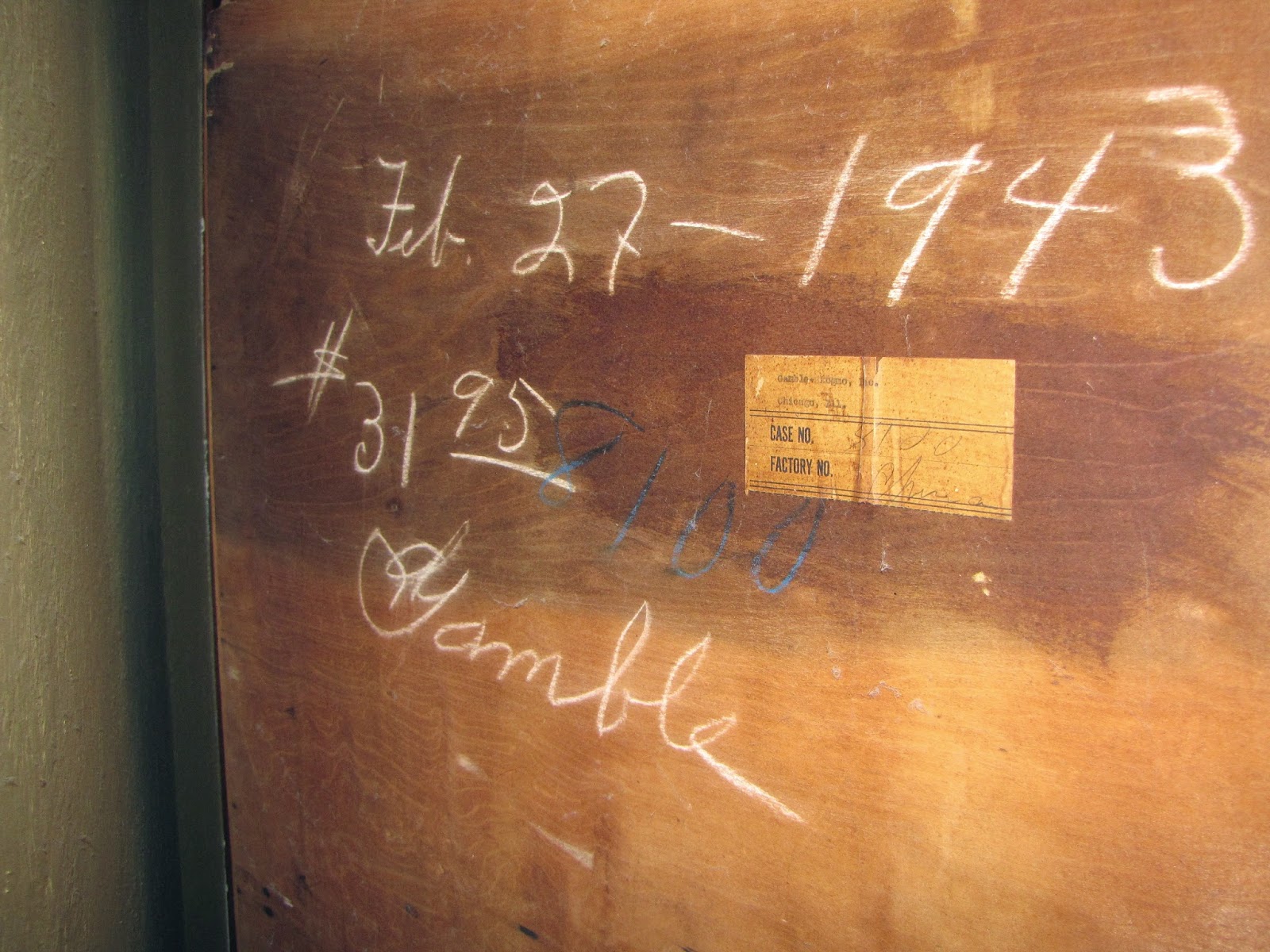 |
| writing on the back of it: Feb. 27 ~ 1941 $31.95 Gamble |
Why the handwriting on the back? Seems that was the thing to do. Write the price and the purchase year. The matching server resides in our garage. Needed more room in my house for the piano.
Another piece I have of Grandma's is what we call the game chest. It stored the table games. I use it now as an armoire. It is solid wood and houses our bedroom TV on top. When Dad, my sister Brenda, and I were moving this heavy piece downstairs, Grandma's writing on the back revealed something. What we saw made it even more special.
 |
| the game chest |
 |
| Grandma wrote ~ Our Father gave this dresser to me in 1929 ~ which he made himself ~ Mrs. Pete ~which I appreciate |
It took us awhile to decipher Grandma's spelling. I thought she wrote apricot, but it was appreciate. My Great Grandpa, Michael Hofer #2, made the game chest. He was a blacksmith and a carpenter of sorts.
Precious. Just precious. Just like time with Grandma Elizabeth would be.
Some day, I hope those five-year diaries of Grandma's will be mine. And maybe someday, one of my greats will cherish mine.
Do you have a relative you've never met that you wish you could spend time with? What traits have you inherited from them?
Writer's note: this is a continuation of last week's post, Seven Silly Tidbits, written in response to a challenge from my online friend, Shelli Littleton. She tagged me to post random facts about myself.
Subscribe to:
Posts (Atom)